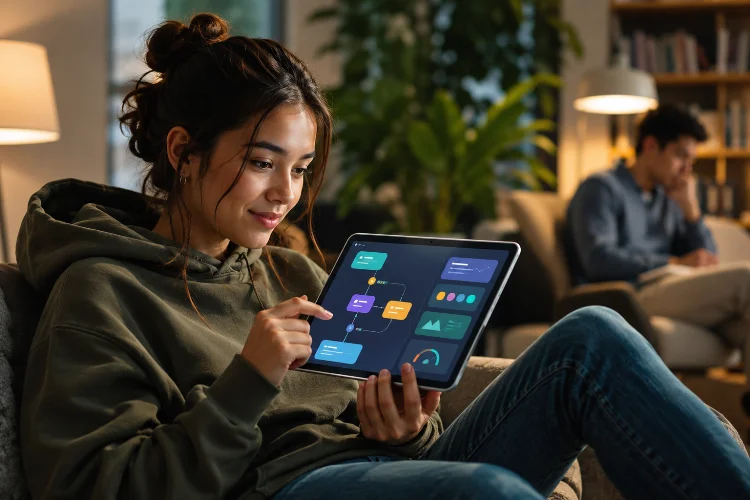
Two students can open the same mathematics app and need completely different things. One may understand fractions but struggle with decimals, while another has already mastered both and is ready for more difficult problems.
Traditional one-size-fits-all learning does not always handle those differences well.
Personalised learning apps try to solve the problem by adjusting parts of the learning experience according to each student’s performance, pace, knowledge gaps, and sometimes personal goals.
The OECD describes personalised learning as providing students with appropriate tasks and support based on a diagnosis of what they know and where gaps remain.
Digital systems such as intelligent tutoring and adaptive-learning platforms can help create those individualized paths.
Understanding how personalised learning apps adapt to student needs is therefore not simply about artificial intelligence choosing the next lesson.
Good personalization combines assessment, feedback, flexible pacing, recommendations, learner choice, and teacher involvement.
When those elements work together, students can spend less time repeating what they already know and more time working on what actually helps them progress.
1. Personalised Learning Starts by Understanding the Learner
An app cannot adapt effectively without first collecting some information about what a learner knows.
This might begin with a diagnostic quiz, several introductory exercises, or the student’s previous course activity.
Imagine someone joining an English vocabulary app.
The system might present 30 words at different difficulty levels. If the learner already understands common terms but struggles with academic vocabulary, future activities can focus more heavily on the weaker area.
This creates a starting profile.
The profile does not have to be permanent. As students complete lessons, answer questions, request hints, and review material, the system gathers new evidence about their current understanding.
The OECD notes that adaptive systems can diagnose knowledge and knowledge gaps and use those insights to provide appropriate tasks or scaffolding.
In other words, personalization begins with a simple question:
What does this learner need right now?
2. Apps Can Adjust the Difficulty of Learning Activities
One of the clearest forms of personalization is adaptive difficulty.
Suppose a student correctly answers several beginner algebra questions without needing hints. Instead of continuing with more easy problems, the app can gradually introduce harder equations.
Another learner who struggles might receive simpler examples, additional explanations, or guided practice.
This creates different learning paths inside the same course.
The Education Endowment Foundation notes that digital technology can be used effectively for individualised instruction, although evidence also supports combining technology with teacher-led or small-group support where appropriate.
The important thing is keeping the level challenging without making it frustrating.
If every activity feels too easy, students may lose interest. If every question feels impossible, they may assume they simply cannot understand the subject.
Good adaptive learning aims for the space between those extremes.
3. Learning Pace Can Change From Student to Student
Students do not all learn at the same speed.
One person might understand a concept after a single explanation, while another needs several examples and extra practice.
Personalised learning apps can give learners more flexibility over that pace.
A student who quickly masters multiplication might move ahead without completing twenty nearly identical exercises. Someone who needs more time can continue practicing without feeling pressured because the rest of the class has already moved on.
This flexibility is one reason digital systems are frequently associated with personlised learning.
OECD research on digital education notes that AI-enabled adaptive learning and intelligent tutoring systems can support individualized learning pathways and provide diagnostic information that may help teachers understand student performance.
However, faster is not always better.
A strong app should prioritize understanding over simply allowing learners to race through content.
4. Smart Recommendations Can Decide What Comes Next
Think about how streaming platforms recommend another movie after you finish watching one.
Learning apps can use a similar concept, although the goal is educational rather than entertainment.
Suppose a learner completes a lesson about percentages but performs poorly on questions involving percentage increases.
Instead of simply opening the next chapter, the app might recommend:
Review Percentage Increase – 7 minutes
Then, once performance improves, it could suggest moving forward.
Intelligent tutoring systems are specifically designed to provide adaptive and personalised educational experiences using information about learner performance.
Recommendations can also include optional practice, harder challenges, revision activities, or different forms of explanation.
The best recomendations should have a clear educational reason.
Students should not be pushed toward another lesson merely because the platform wants them to stay active longer.
5. Feedback Can Adapt to Different Mistakes
Two wrong answers are not always wrong for the same reason.
Imagine two students solving:
3 × (4 + 2)
Student A answers 18.
Student B answers 14.
Both are incorrect, but they probably made different mistakes.
A sophisticated learning system can sometimes identify patterns in those errors and provide more targeted feedback.
Instead of simply displaying Incorrect, it might explain the relevant rule, provide a hint, show a similar example, or recommend reviewing an earlier concept.
This reflects a broader principle of adaptive teaching: information about student understanding should influence what happens next.
The Education Endowment Foundation describes adaptive teaching as responding to evidence about learning and adjusting support to better match pupil needs.
Feedback becomes much more valuable when it helps students understand why they made a mistake.
6. Personalised Review Can Focus on Weak Areas
Learning does not end when a student gets something right once.
They also need to remember it later.
Personalised apps can track which topics learners repeatedly forget or answer incorrectly and bring those concepts back during later study sessions.
Imagine a language learner who knows 500 words but repeatedly forgets 25 of them.
It would make little sense to review all 500 words equally.
Instead, the app can prioritize the difficult vocabulary while showing well-mastered words less frequently.
This type of targeted revision makes study time more efficient.
It also gives students a clearer sense of where they should focus rather than asking them to review an entire course every time an exam approaches.
Digital tools become particularly useful here because they can record patterns across many learning sessions-something that would be difficult for learners to track manually.
The goal is not to create endless repetition. It is to use assesment information to decide what deserves another look.
7. Student Choice Is Also Part of Personalisation
Personalized learning should not mean that an algorithm makes every decision.
Students can have a role too.
A learning app might let users select study goals, preferred session lengths, optional topics, difficulty settings, or different activities.
For example, someone learning photography might choose between:
Practice Camera Settings
Explore Composition
Review Previous Mistakes
The system can still recommend a route while allowing the learner some control.
Research and policy discussions around personalized learning often include learner needs, strengths, interests, and opportunities for greater flexibility rather than treating personalization only as automatic content delivery.
This matters because education is not simply a sequence of algorithmic decisions.
Learners also need to develop skills such as goal setting, self-monitoring, and deciding when they need help.
The Education Endowment Foundation notes that metacognitive and self-regulation strategies can support learners in planning, monitoring, and evaluating their own learning.
Good personalization supports those skills rather than replacing them.
8. Teachers Still Matter in Personalised Digital Learning
One common mistake is imagining that adaptive apps can replace teachers.
Technology can analyze answers quickly, identify patterns, recommend practice, and deliver immediate feedback. But it does not automatically understand every reason a learner is struggling.
A student may be tired, anxious, distracted, confused by the wording of a question, or missing background knowledge that the system has not identified.
Teachers can add that human context.
They can interpret learning data, notice emotional or social factors, change instructional approaches, and decide whether the app’s recommendation actually makes sense.
EEF guidance on individualised instruction similarly notes that digital approaches are often used alongside teacher or small-group support rather than operating completely independently.
The strongest model is usually not teacher versus technology.
It is teacher plus technology, with each doing what it does best.
9. Personalisation Needs Limits, Privacy, and Good Judgment
Personalised learning usually depends on data.
Apps may track answers, progress, mistakes, time spent on activities, course history, and other patterns.
That creates an important responsibility.
Learners should understand what information is being collected and how it is being used. Systems also need appropriate safeguards, especially when they are used by children.
UNESCO warns that while AI can support personalised learning and diverse learner needs, rapid technological development also creates policy, governance, ethical, and privacy challenges.
UNESCO has also challenged overly simplistic claims that AI-powered personalization automatically represents the ideal future of education, arguing for more careful examination of what is actually being personalised and who controls those decisions.
That is an important reminder.
An algorithm’s recommendation is not automatically correct simply because it uses data.
Personalization should remain transparent, consistant, educationally meaningful, and open to human judgment.
Personalised learning apps adapt to student needs by using evidence from assessments, learning activity, progress, and learner choices to adjust what happens next.
They can change difficulty, provide targeted practice, recommend review topics, adapt feedback, support different learning speeds, and help students focus on areas where they need the most improvement.
Used well, these features can make digital learning feel less like a fixed course and more like a responsive learning journey.
However, personalization works best when technology supports rather than controls the learner. Teacher judgment, student choice, privacy, and meaningful educational goals still matter.
If you are evaluating a learning app, look beyond whether it claims to be “personalized.” Ask what actually changes for each student, what data drives those decisions, and whether the adaptations genuinely help learners understand more.