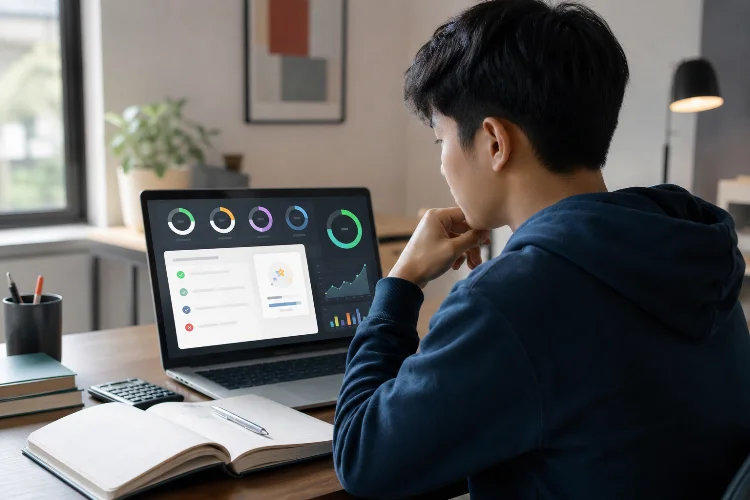
Imagine finishing an online mathematics lesson and immediately seeing which concepts you understand, which questions caused trouble, and what you should review next. That is much more useful than simply receiving a score several days later.
Digital assessments can make this kind of feedback possible.
Instead of treating assessment as something that happens only at the end of a course, online learning platforms can use quizzes, assignments, simulations, practice activities, and learning analytics throughout the learning journey.
The OECD notes that digital assessment can support new ways of measuring knowledge and skills while creating richer information about how learners interact with assessment tasks.
Understanding how digital assessments measure student learning progress is therefore about more than replacing paper tests with screens.
When designed well, these tools can show what students know, identify learning gaps, provide faster feedback, and help teachers decide what should happen next. But technology alone does not make an assesment useful. The questions still need to measure the right things.
1. Digital Assessments Collect Evidence of Learning
At its core, assessment is about collecting evidence.
A teacher wants to know whether students understand a concept, can apply a skill, or need additional support. Digital tools simply provide new ways of gathering that evidence.
A learning platform might use multiple-choice questions, short written answers, interactive exercises, projects, simulations, or uploaded assignments.
For example, after a lesson on percentages, students might complete ten questions online. Instead of recording only the final score, the platform could show which types of percentage problems caused the most difficulty.
That information gives teachers a more detailed picture of learning.
Formative assessment is particularly useful here because it gathers evidence while learning is still happening.
The U.S. Department of Education’s LINCS resource describes formative assessment as using assessment information to provide feedback to teachers and learners during instruction so teaching and practice can be adjusted.
The important question is not simply, “What score did the student get?”
It is, “What does that score tell us about what the student currently understands?”
2. Frequent Quizzes Can Reveal Learning Gaps Early
Waiting until the final exam to discover that students misunderstood an important concept is not ideal.
Small digital assessments can identify problems much earlier.
Imagine an introductory coding course divided into ten modules. After every module, students complete five short questions or one practical coding exercise.
If a student consistently struggles with loops but performs well with variables and functions, the system has found a specific learning gap.
That student can review the relevant material before moving into more complicated programming concepts.
Teachers can also see patterns across an entire class.
If 70% of students answer the same question incorrectly, the problem may not be individual students. The lesson itself might need clarification.
The OECD has highlighted the value of formative assessment tools and individualized digital tracking for diagnosing student learning and identifying where additional support may be needed.
Frequent assessment therefore works best when it acts as a checkpoint rather than a constant examination.
3. Immediate Feedback Turns Assessment Into Learning
One major advantage of digital assessment is speed.
Certain question types can be evaluated instantly, allowing learners to receive feedback while the problem is still fresh in their minds.
Suppose a student answers:
What is 25% of 80?
They choose 15.
A weak assessment simply displays:
Incorrect.
A better one explains:
Try again. Convert 25% to 0.25, then multiply 0.25 × 80.
Now the assessment itself becomes part of the lesson.
The student can identify the mistake, retry the question, and strengthen their understanding before continuing.
Formative assessment is specifically intended to create this feedback loop between evidence and subsequent learning decisions.
However, instant feedback is not automatically effective.
An Education Endowment Foundation trial of one digital feedback program in primary mathematics found no evidence of improved mathematics outcomes, reminding us that technology and feedback features need sound instructional design rather than being assumed to work automatically.
Good feedback should explain, guide, and encourage another useful attempt.
4. Progress Tracking Shows Change Over Time
One assessment tells you how a student performed at one moment.
A sequence of assessments can show a trend.
Imagine a learner taking weekly vocabulary tests:
Week 1: 58%
Week 2: 64%
Week 3: 72%
Week 4: 81%
The important information is not just the 81% score. The pattern suggests that performance is improving over time.
Digital learning platforms can organize this information into dashboards showing completed activities, assessment results, skill mastery, and progress toward course objectives.
Teachers can then compare current performance with earlier results.
Students can benefit too.
Seeing progress can make learning feel less abstract, especially in subjects where improvement happens gradually.
However, dashboards should avoid creating the illusion that every learning process can be reduced to a neat percentage. A learner who has completed 80% of a course has not necessarily mastered 80% of the subject.
Progress indicators work best when connected to meaningful evidence of learning rather than simple activity completion.
5. Adaptive Assessment Can Adjust to the Learner
Traditional tests usually give everyone the same questions.
Digital assessments can sometimes behave differently.
An adaptive assessment changes what happens next based on a learner’s previous responses.
Suppose a student correctly solves several beginner-level algebra questions. The system may begin presenting more difficult problems.
Another learner who struggles with the same questions might receive simpler items that help identify exactly where the misunderstanding begins.
This allows the assessment to gather more targeted information.
The OECD’s work on innovative assessments discusses how digital technologies can support technology-enhanced and embedded assessment models that go beyond conventional testing formats.
Adaptive systems can also support personalized learning recommendations.
If assessment data suggests a learner already understands Topic A but has difficulty with Topic B, the platform can prioritize additional practice for Topic B rather than requiring equal repetition of everything.
Still, adaptive technology needs careful design.
A computer making more decisions does not automatically make the measurment more accurate. The underlying questions, scoring rules, and educational objectives still determine what the assessment actually tells us.
6. Digital Tasks Can Measure More Than Multiple-Choice Answers
Digital assessment does not have to mean clicking A, B, C, or D.
Technology can create richer tasks.
A science assessment might use a simulation where students change variables and observe experimental results.
A geography task could ask learners to analyze an interactive map.
Programming students might write actual code and see whether it produces the expected output.
Language learners could record spoken responses instead of answering only written questions.
These activities can provide evidence about how learners apply knowledge rather than simply whether they remember a fact.
The OECD has explored technology-enabled assessment specifically as a way of measuring and supporting more complex skills that may be difficult to capture through traditional formats.
UNESCO has similarly noted that technology-based assessment can provide opportunities for timely feedback and new forms of assessment, although implementation varies considerably across education systems.
The format should always match the skill being measured.
You would not assess swimming ability with a multiple-choice test alone. Digital education should follow the same logic.
7. Teachers Can Use Assessment Data to Adjust Lessons
Assessment data becomes valuable when someone does something with it.
Suppose a dashboard shows that most students understand photosynthesis but repeatedly struggle with cellular respiration.
The teacher now has several options.
They could reteach the difficult concept, provide another example, assign additional practice, create small support groups, or change the explanation used in the original lesson.
This is what makes formative assessment different from simply recording marks.
The evidence informs the next teaching decision.
The OECD’s 2025 work on formative assessment and feedback notes that aligned assessment tools and individualized digital tracking can help teachers diagnose student learning.
However, educators should avoid becoming overwhelmed by data.
A dashboard containing fifty metrics is not necessarily more useful than one showing three clear indicators connected to important learning objectives.
Good analytics should make educational decisions easier, not turn teachers into full-time data analysts.
8. Assessment Results Need Context
Digital systems are very good at counting things.
They can record correct answers, incorrect attempts, completion times, clicks, submitted exercises, login frequency, and dozens of other variables.
But measurable activity is not always the same as learning.
A student who opens an app every day may understand less than someone who studies twice a week but completes deeper practice.
Similarly, answering a question quickly does not necessarily indicate mastery. The learner may simply be guessing.
This is why assessment results need interpretation.
OECD research on digital technologies emphasizes that access to technology alone does not guarantee educational improvement; benefits depend on how tools are designed and integrated into teaching and learning.
Teachers can combine digital data with discussions, projects, observation, written work, and other evidence.
Using several sources creates a more complete picture than relying on a single dashboard score.
9. Good Digital Assessment Measures What Actually Matters
Perhaps the biggest challenge is deciding what should be measured.
It is easy to build an online quiz that tests factual recall because those answers can be automatically scored.
Measuring creativity, reasoning, collaboration, ethical judgment, or the quality of an argument is harder.
But difficult-to-score skills should not be ignored simply because software cannot grade them instantly.
UNESCO has recently emphasized this challenge in discussions about assessment in the age of AI, arguing for greater attention to higher-order thinking, creativity, and other meaningful capabilities rather than relying too heavily on rote knowledge.
A strong digital assessment strategy can therefore mix automatically scored questions with projects, explanations, peer activities, teacher-reviewed work, and realistic tasks.
The technology should serve the learning objective-not determine it.
That distinction keeps digital assesments educationally meaningful rather than simply convenient.
Digital assessments can provide a much clearer picture of student learning when they are used throughout the learning process rather than only for final grades.
Short quizzes can reveal gaps, immediate feedback can support correction, progress data can show improvement, adaptive tasks can target individual needs, and richer digital activities can assess how students apply knowledge.
Teachers can then use this evidence to adjust instruction and provide more appropriate support. But a score is never the complete story. Digital data needs context, thoughtful interpretation, and strong assessment design.
If you are creating an online course, start by reviewing each assessment and asking: What exactly does this activity tell me about the learner?
When every question connects to a meaningful learning objective, digital assessment becomes more than testing-it becomes a tool for guiding progress.