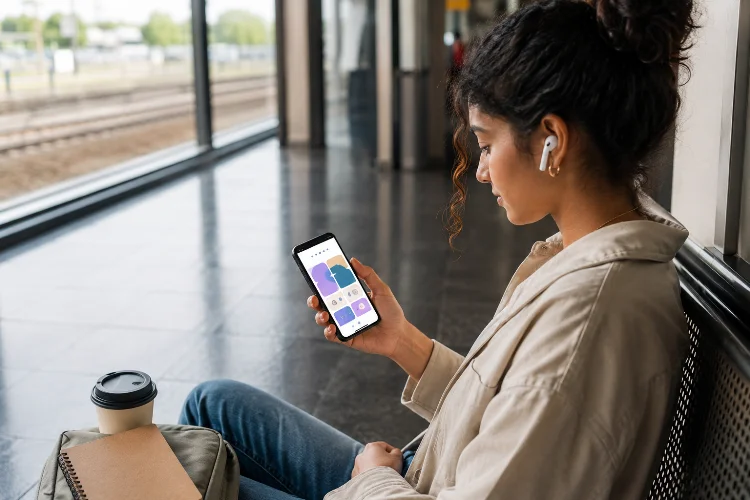
Finding an hour to study can feel difficult. Finding ten minutes between classes, during a commute, or before dinner is usually much easier.
That simple idea sits at the heart of microlearning.
Microlearning organizes education into small, focused learning units that can usually be completed within a short period. UNESCO-UNEVOC describes it as learning through small, bite-sized units that can be combined into larger lessons, modules, or programs.
Instead of asking learners to work through a long chapter or lecture in one sitting, it might focus on one concept, one skill, or one problem at a time.
Understanding what microlearning is and how it supports study is especially useful in a world where learning increasingly happens across smartphones, laptops, online courses, and busy daily schedules.
However, microlearning is not simply about making everything shorter. Effective micro lessons need a clear objective, meaningful content, practice, and a connection to the larger learning journey.
1. What Is Microlearning?
Microlearning is an instructional approach that delivers focused educational material in small units.
A systematic review published in 2025 described it as targeted, action-oriented, bite-sized content designed to achieve specific objectives within a short amount of time, often ranging from seconds to minutes.
A microlearning activity could be a five-minute video, a short reading, several flashcards, a quick quiz, an infographic, a short simulation, or one practical exercise.
For example, instead of creating a two-hour lesson called Introduction to Photography, a course might divide it into:
Understanding Aperture
Choosing Shutter Speed
How ISO Works
Balancing Exposure
Each activity focuses on one manageable objective while contributing to a larger subject.
The important part is not the exact number of minutes. A short lesson that tries to explain twenty different ideas at once is still poorly designed.
Good microlearning is short and focused.
2. Short Lessons Make Study Easier to Fit Into Daily Life
One of microlearning’s biggest strengths is flexibility.
Learners do not always have long uninterrupted periods available. University students may have classes and assignments, employees have work responsibilities, and adult learners often balance education with family life.
Short learning activities lower the amount of time needed to begin.
Someone learning Spanish might practice ten vocabulary words while waiting for a bus. A student could review one chemistry concept before class. An employee could complete a short cybersecurity exercise between meetings.
Research on microlearning describes its ability to support asynchronous, on-demand study, allowing learners to access a resource when and where they need it.
That does not mean students should study every spare minute.
The advantage is simply that learning becomes easier to place around real life instead of requiring real life to be reorganized around every study session.
3. Microlearning Can Make Large Topics Feel More Manageable
A 300-page textbook or 40-hour online course can feel intimidating before a learner even begins.
Breaking the same subject into smaller milestones can change that feeling.
Imagine an introductory web-development course.
Instead of seeing:
HTML Course – 12 Hours
the learner might see:
What Is HTML? – 6 minutes
Create Your First Heading – 5 minutes
Add a Paragraph – 6 minutes
Build a Link – 8 minutes
Quick Practice – 7 minutes
The total amount of learning may eventually be substantial, but each next step feels achievable.
Research reviews have found microlearning being used across higher education, online and blended learning, professional development, and workplace training.
This approach can be especially helpful for beginners because it creates a clear sequence instead of presenting the subject as one enormous challenge.
4. Focused Units Can Reduce Unnecessary Cognitive Load
Working memory is limited. Trying to process too much unfamiliar information at the same time can make learning harder.
Microlearning can help by limiting each learning activity to a smaller amount of information.
A 2025 study discussing microlearning and cognitive load noted that concise, focused content may help reduce unnecessary cognitive demands and improve learning efficiency.
Suppose someone is learning spreadsheet formulas.
Teaching SUM, AVERAGE, IF, VLOOKUP, conditional formatting, pivot tables, and charts in one session could quickly become overwhelming.
A microlearning structure might introduce one formula, show two examples, provide a short exercise, and then stop.
The learner has time to understand that piece before adding another.
However, designers should not seperate ideas that need to be understood together. Complex reasoning sometimes requires learners to see relationships across several concepts.
Microlearning should simplify the learning path, not fragment it.
5. Microlearning Works Well for Regular Review
Learning something once does not guarantee that you will remember it.
Short activities are particularly useful for bringing previously learned material back into a student’s study routine.
Imagine finishing a biology unit about cells on Monday.
Instead of leaving the topic untouched until an exam four weeks later, a learning app could provide several short review activities over the following days.
Wednesday might include five questions about cell structures.
Friday could include a diagram-labeling exercise.
The following week might include a short comparison between plant and animal cells.
This makes review easier to integrate without requiring students to repeat an entire lesson.
Research in health-professions education has reported positive outcomes from microlearning in areas including knowledge, confidence, retention, and studying, although researchers also note that more evidence is needed for some higher-level outcomes.
Micro lessons therefore work particularly well as reinforcement rather than simply as one-time content.
6. Mobile Devices Make Microlearning Easy to Access
Microlearning and smartphones naturally fit together.
Short activities can be designed specifically for smaller screens and brief study periods. Learners might watch a short explanation, complete five flashcards, answer a quiz, or listen to an audio clip without opening a laptop.
A review of mobile microlearning noted that mobile applications can make short learning experiences available when learners need them and help integrate education into everyday routines.
Good mobile microlearning still requires thoughtful design.
Text should be readable without zooming. Buttons should be easy to tap. Videos should not require enormous downloads, especially for learners with limited mobile data.
Offline access can improve the experience further.
A student could download several micro lessons over Wi-Fi, complete them during a journey, and synchronize progress later.
That flexibility makes microlearning particularly practicle for learners who frequently move between locations.
7. Quick Practice Can Make Micro Lessons More Effective
A short video alone is not necessarily a complete learning activity.
Learners benefit when they have to do something with the information.
Suppose a five-minute economics lesson explains supply and demand.
Instead of ending immediately after the explanation, the lesson could show a simple scenario:
A popular concert has 20,000 fans trying to buy 5,000 tickets. What would you expect to happen to ticket prices?
Now the learner needs to apply the concept.
A coding micro lesson might explain one command and then ask students to write a short line of code. A language lesson could introduce five words and finish with a matching exercise.
This creates a simple rhythm:
Learn → Practice → Feedback
Microlearning research has found positive effects in a range of contexts, but effectiveness varies depending on implementation, learner characteristics, and the type of material being taught.
Making students active rather than passive can help each small unit accomplish something meaningful.
8. Microlearning Should Connect to a Larger Learning Path
One danger of bite-sized education is fragmentation.
A learner might complete dozens of interesting five-minute lessons without understanding how the ideas connect.
Good microlearning therefore needs structure.
Imagine learning personal finance through unrelated lessons about credit cards, investing, budgeting, mortgages, and taxes presented in random order.
Each lesson could be useful individually, but the experience would lack direction.
A stronger course might organize them into a pathway:
Managing Income → Building a Budget → Saving → Managing Debt → Investing
Individual micro lessons then sit inside each stage.
UNESCO’s recent discussion of microlearning ecosystems similarly emphasizes connecting smaller learning opportunities within coherent educational environments rather than treating isolated content as the whole experience.
Students should always understand how today’s small lesson contributes to tomorrow’s larger skill.
9. Microlearning Cannot Replace Every Type of Study
Not every subject should be compressed into five-minute pieces.
Writing an academic essay, conducting an experiment, analysing a novel, designing software, or solving a complicated engineering problem requires extended concentration.
Microlearning works better as one tool within a broader learning strategy.
It may introduce a concept, provide a quick demonstration, reinforce previous knowledge, prepare students for a longer class, or provide just-in-time support.
Then deeper activities can ask learners to connect those smaller pieces.
Research reflects this nuance. Although systematic reviews generally report promising learning outcomes, studies also identify limitations and show that effectiveness is not automatic across every context.
The question should therefore not be:
“Can we make this lesson shorter?”
A better question is:
“Would breaking this material into smaller units make it easier to learn?”
Sometimes the answer will be yes. Sometimes learners genuinely need an uninterrupted hour.
Microlearning turns larger educational goals into small, focused learning experiences that are easier to fit into everyday schedules.
Short videos, quizzes, readings, flashcards, and practical exercises can help learners focus on one objective, review important material, and make steady progress without requiring long study sessions every time.
Research suggests promising benefits across several educational contexts, although effective design and appropriate use remain essential.
The best approach is to combine small lessons with deeper learning. Use microlearning for explanations, review, practice, and reinforcement, then connect those pieces through projects and more complex activities.
If you are planning an online course or study routine, try dividing one large topic into several clear objectives. Make each unit useful on its own, but ensure every piece leads toward a larger understanding.